Introduction: Beyond the Static Dashboard
For the past decade, the Industrial Internet of Things (IIoT) promised a revolution through "Big Data." However, for many facility managers, this resulted in "Data Fatigue" — dashboards filled with red lines that still required a human expert to diagnose and fix.
As we move through 2026, the paradigm has shifted. We are entering the era of Agentic AI at the Edge. This isn't just a chatbot; it is a system that perceives a fault, reasons through the technical manual, and executes a recovery plan autonomously.
What is Agentic AI in an Embedded Context?
Traditional Edge AI is reactive — simple pattern recognition to flag an anomaly (e.g., "Motor vibration has exceeded 5mm/s"). Agentic AI is proactive. By utilizing Small Language Models (SLMs) — quantized versions of models like Phi-4-Mini or Llama-3-Edge — the system can perform "Chain-of-Thought" reasoning. When an anomaly is detected, the agent initiates a ReAct (Reason + Act) loop: Observation (motor temperature rising), Reasoning (cross-referencing the lubrication schedule via local RAG), and Action (throttling the VFD and ordering a technician via the ERP API).
The Technical Pillars of 2026 Edge Intelligence
- On-Device SLMs and NPU Acceleration — modern microcontrollers (like the ESP32-P4 or nRF54 series) now feature dedicated Neural Processing Units, allowing 4-bit quantized SLMs to run locally so critical decisions stay within the factory firewall.
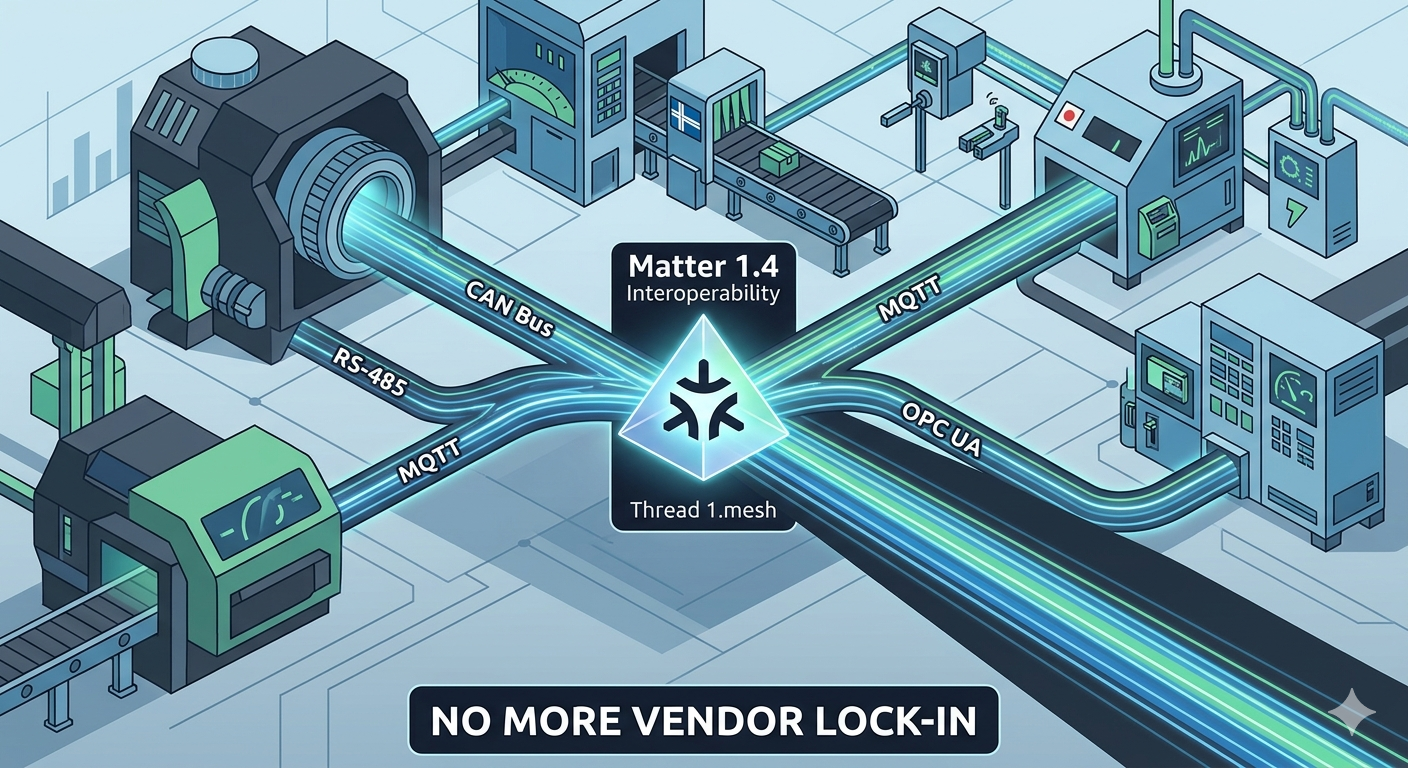
- The Model Context Protocol (MCP) — acts as a universal translator, letting the AI agent query Modbus registers, CAN bus frames, and MQTT topics through a standardized interface, removing the need for custom-coded drivers per sensor.
- Local RAG (Retrieval-Augmented Generation) — by storing technical manuals, circuit diagrams, and maintenance logs in a local vector database at the edge, the AI can "read" the manual in real time to troubleshoot a fault without human intervention.
Why This Matters for Your Bottom Line
The transition to Agentic AI solves the "Expert Gap." With a global shortage of specialized maintenance engineers, a system that can self-triage reduces Mean Time to Repair (MTTR) by up to 60% — with zero-latency, on-premise decisions and operational continuity for junior technicians.
Conclusion: The Future is Autonomous
At JESilix, we specialize in bridging the gap between legacy industrial hardware and the next generation of Agentic intelligence — Intelligence where it matters most, at the edge.